






Across North Texas, from Garland to Plano and Mesquite, auto repair shops are increasingly using AI-assisted diagnostic tools to identify vehicle issues faster and more accurately. At Jupiter Chevrolet, a family-owned dealership serving Garland since 1925, our technicians use these tools alongside decades of hands-on expertise to deliver faster, more reliable service.
How AI-Assisted Diagnostics Work
Modern vehicles function as networks of interconnected computers, generating constant streams of sensor data. AI-assisted diagnostic tools analyze that data, comparing real-time readings against known fault patterns to identify the likely cause of an issue faster than manual testing alone. Rather than replacing a technician’s judgment, these tools narrow down the possibilities so a certified technician can confirm the diagnosis and move directly to the repair.
This matters most in vehicles with advanced driver-assistance systems (ADAS), high-voltage EV batteries, and complex electronic control units, all areas where pinpointing the actual cause of a warning light or performance issue can otherwise take hours of manual troubleshooting.
What This Means for Service at Jupiter Chevrolet
Picture a customer arriving with a Chevrolet Trax showing a check-engine light. AI-assisted diagnostic tools help our technicians quickly narrow down the likely cause, in many cases a routine issue, well before extensive manual testing would otherwise be required. That speed translates directly into shorter wait times and fewer surprises for customers commuting from Richardson, McKinney, or anywhere across the metro.
These same tools support predictive maintenance, helping our service team flag developing issues before they become breakdowns. For vehicles covered under Jupiter Chevrolet’s Lifetime Powertrain Warranty on qualifying purchases, catching issues early also helps keep warranty claims straightforward.
Why Faster, More Accurate Diagnostics Matter
In a region where reliable transportation is essential for daily commutes and longer trips alike, the value of faster, more accurate diagnostics is straightforward: fewer unnecessary parts replaced, fewer repeat visits for the same issue, and more confidence that a repair actually addressed the root cause. This is true whether you’re bringing in a Corvette, a Silverado, or a Bolt EV with battery-specific diagnostic needs.
AI-assisted tools are also useful for connected vehicles. Models with Chevrolet Connected Services can transmit vehicle health data directly, allowing our service team to flag potential issues even before a customer notices a symptom.
Frequently Asked Questions
Does AI diagnostic technology replace the need for a skilled mechanic?
No. AI-assisted diagnostic tools help technicians narrow down the likely cause of an issue faster, but a certified technician still confirms the diagnosis, performs the repair, and verifies the fix. The technology supports expertise; it doesn’t replace it.
Can AI diagnostics catch problems before they cause a breakdown?
Yes, in many cases. Predictive diagnostic tools analyze vehicle data to flag developing issues, such as a component showing early signs of wear, before they lead to a failure. This is especially useful for vehicles under warranty, where catching an issue early can simplify the repair process.
How does this benefit EV owners specifically?
Electric vehicles rely on high-voltage battery systems and complex software that require specialized diagnostic approaches. AI-assisted tools help technicians monitor EV battery health and catch potential issues early, which is particularly valuable for models like the Chevrolet Bolt EV or Blazer EV.
Disclaimer: This content is provided for general informational purposes. Specific diagnostic capabilities vary by vehicle model and service technology in use; contact our service team for details on your vehicle.
Schedule Service at Jupiter Chevrolet
Jupiter Chevrolet’s service center is located at 11611 LBJ Freeway in Garland and serves the Dallas metro, including Plano, Frisco, McKinney, Richardson, and Mesquite. Our certified technicians combine AI-assisted diagnostic tools with genuine Chevrolet parts and factory training. Schedule service online or contact our team with questions about your vehicle.
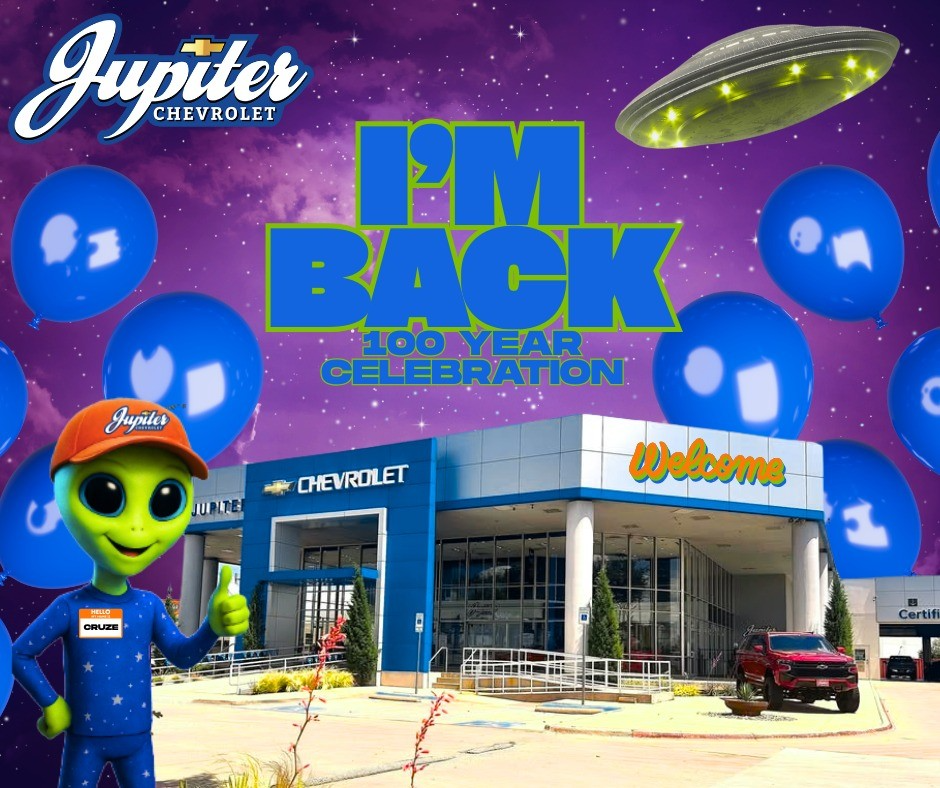
Big news from Jupiter Chevrolet — our beloved mascot Cruze has officially landed back in Garland, TX, just in time for our 100-Year Celebration! 🎉 From 1925 to 2025, Jupiter Chevrolet has proudly served generations of drivers across Garland and the DFW area with honesty, dedication, and a passion for all things Chevrolet.
🌌 A Century of Service, Smiles & Chevrolets
For 100 years, we’ve grown right alongside our incredible community — from classic Chevrolets of the past to the cutting-edge electric vehicles of the future. Whether it’s your first car, your family SUV, or a Silverado built for work and adventure, Jupiter Chevrolet has always been here to keep you moving forward.
Read the rest of this entry »
Quick Listen:
In the vast expanse of the Dallas-Fort Worth metroplex, where endless highways connect bustling cities and quiet suburbs, Chevrolet dealerships are proving they’re essential to more than just the automotive landscape. They’re integral to the social and economic fabric of North Texas, supporting everything from school programs to major festivals. Take Jupiter Chevrolet in Garland, a family-owned staple that’s been championing local causes since 1925, marking its centennial this year with renewed commitment to community ties.
Feeling stuck in the stressful car-buying process? At Jupiter Chevrolet in Garland, TX, we’ve reimagined how buying a car should feel. With transparent pricing, online deal-building tools, and the benefits of our Jupiter Advantage program, we ensure every step is straightforward and satisfying. Skip the hassle. From purchase, to certified service and parts, to collision repair and body shop. Our team puts your convenience, safety, and confidence first. Turn your dreams of finding your ideal Chevrolet into reality with us. Visit Jupiter Chevrolet today!
Community Events Drive Home Chevrolet’s Role in North Texas Transportation
Chevrolet’s footprint in North Texas stretches far beyond the showroom floors of dealerships in Garland, Richardson, and Plano. These locations serve as vital community hubs, fostering connections through sponsorships of sports teams, family-oriented events, and sustainability initiatives. In an industry where brand loyalty hinges on trust and reliability, Chevrolet’s approach exemplifies how deep local engagement can drive long-term success in automotive retail and service.
This strategy aligns perfectly with robust market trends. Analysis from Cox Automotive’s vAuto Live Market View reveals that retail used-vehicle sales reached 1.66 million units in March 2025, marking a 9.4 percent increase from February and a 12.2 percent growth year-over-year. The day’s supply for used vehicles dropped to 39, a decrease of four days from the revised early-March figure. As Scott Vanner, Cox Automotive’s manager of Economic and Industry Insights, observed, March typically sees the year’s strongest used-vehicle retail performance, boosted this time by tax refunds and discussions around tariffs, achieving the highest sales since 2021. For Chevrolet dealers, these figures underscore an opportunity to leverage community involvement to boost inventory turnover and customer retention.
Revving Up Community Engagement
The vibrancy of North Texas communities shines through in their diverse events, and Chevrolet dealerships are increasingly central to these gatherings. Across Dallas, McKinney, and Frisco, dealers invest in youth sports, arts festivals, and cultural celebrations, transforming sponsorships into interactive experiences. At events like the Plano Balloon Festival and Richardson’s Wildflower! Arts & Music Festival, Chevrolet vehicles often take center stage, offering test drives of models like the Equinox and Trax amid the excitement of balloons and live performances.
Economic development efforts in cities such as Garland and Mesquite further illustrate Chevrolet’s contributions through transportation collaborations. As urban expansion accelerates, dealerships provide vehicles for public events and partner on mobility projects. This role is crucial in a state where the freight and logistics market is poised for significant expansion, valued at USD 97.11 billion in 2025 and projected to hit USD 120.09 billion by 2030, growing at a compound annual rate of 4.34 percent. Chevrolet’s trucks and SUVs support this sector, aiding logistics operations and daily commutes, solidifying the brand’s position in North Texas’s thriving economy.
Beyond statistics, real stories highlight the impact. Jupiter Chevrolet, for instance, has long emphasized community first, supporting local schools and sports programs. Their involvement includes sponsoring Teacher of the Month awards in Garland ISD, recognizing educators and providing resources for schools. This family-owned dealership, celebrating 100 years of service in 2025, continues to build trust through such initiatives, from hosting EV demonstrations to participating in local outreach.
Chevrolet in Action: Real-World Impact
Navigating through Garland, one can’t miss Chevrolet’s touch on everyday community life. Partnerships with Garland ISD extend to athletics sponsorships, where dealerships like Jupiter supply shuttle vans for events like band practices and sports meets, ensuring safe and reliable transportation for students and families. In Dallas, Chevrolet vehicles often headline parades for fundraising, their modern aesthetics drawing attention while bolstering nonprofit efforts.
Further north, in Plano and McKinney, business expositions feature Chevrolet’s electric lineup, including the Blazer EV and Silverado EV, attracting environmentally aware visitors interested in sustainable driving options. These showcases not only promote innovation but also educate attendees on the benefits of EVs in reducing urban emissions.
Grapevine’s Main Street Festival provides a practical demonstration of Chevrolet’s utility. Chevy trucks handle behind-the-scenes logistics, transporting supplies for vendors and supporting the event’s smooth operation. Such hands-on involvement resonates deeply with locals, portraying Chevrolet as a dependable ally in community endeavors. Similarly, other North Texas Chevy dealers like Classic Chevrolet of Grapevine host charity fundraisers, raising substantial funds for local causes. El Dorado Chevrolet organizes custom car shows and BBQ cook-offs to benefit foundations like Guns & Hoses of North Texas.
These examples illustrate a broader trend among Chevrolet dealerships in the region. The North Texas Chevy Dealers association, comprising 45 locations, collaborates to amplify their community presence, sponsoring major events and deepening their impact across the Dallas-Fort Worth area. From Sherman Chevrolet’s support of Rodeo Celina to Don Hewlett’s backing of Central Texas nonprofits, the brand’s commitment to local engagement is evident and multifaceted.
Navigating Challenges
Despite these successes, the path isn’t without obstacles. Intense competition from rival automakers at events in Frisco and Rockwall-Heath demands that Chevrolet continually innovate to capture attention. Differentiating through a blend of heritage and cutting-edge technology such as highlighting durable trucks alongside advanced EVs becomes essential.
Consumer preferences are shifting toward sustainability, compelling dealerships to prioritize electric and hybrid vehicles in their promotions. This pressure is compounded by logistical challenges, like managing vehicle and staff schedules for consecutive festivals spanning multiple cities. However, these hurdles encourage adaptability, turning potential setbacks into platforms for demonstrating Chevrolet’s resilience and forward-thinking approach.
Moreover, as the automotive market evolves, dealers must address broader economic factors. With used-vehicle inventory stabilizing, as seen in the 39-day supply noted earlier, strategic community involvement helps maintain visibility and drive sales amid fluctuating demands.
Seizing Opportunities for Growth
Chevrolet dealerships are adept at capitalizing on emerging opportunities to strengthen their community bonds. In areas like Forney and Mesquite, partnerships with institutions such as churches and schools enhance brand visibility and foster enduring trust. Service teams contribute by providing complimentary safety inspections at events envision quick tire checks at a McKinney fair or maintenance clinics at Garland fundraisers, converting service expertise into community goodwill.
Drawing from Dallas-Fort Worth regional mobility analyses, Chevrolet emphasizes its vehicle’s dependability for city and suburban travel, a key message amplified at local gatherings. The push for EV adoption is gaining speed, with interactive charging demos at green expos in Plano and Richardson igniting curiosity in models like the Bolt EUV. This fusion of practicality and innovation positions Chevrolet as a brand attuned to North Texas’s current needs and future aspirations.
Looking at specific dealers, Grubbs Family of Dealerships supports initiatives like the North Texas Angels Pageant, showcasing their multifaceted community role. Jerry’s Chevrolet invites donation and sponsorship proposals that align with their goals, encouraging collaborative efforts. These actions not only boost local economies but also reinforce Chevrolet’s reputation as a community pillar.
Expert Insights and the Road Ahead
Insights from transportation experts in Dallas and Garland forecast sustained demand for versatile family and commuter vehicles, aligning seamlessly with Chevrolet’s diverse SUV and EV offerings. Predictions suggest dealerships will expand their influence in regional mobility projects, including integrations with ridesharing services and the development of charging networks.
To maintain momentum, experts advocate for enhanced civic participation deploying mobile service vans at high-attendance events or crafting targeted messages on sustainability to appeal to green-minded consumers. The optimistic market data, including the stabilized used-vehicle supply at 39 days in March 2025, empowers dealers to invest confidently in these partnerships, converting community engagement into sustained customer loyalty and positioning Chevrolet vehicles as essential to North Texas’s transportation narrative.
Furthermore, as seen with Sewell Sponsorships supporting hundreds of local organizations annually, the collective effort of Chevrolet dealers promises a robust future. This widespread involvement ensures the brand remains intertwined with the region’s growth.
Driving Community, Building Tomorrow
From Garland’s lively avenues to Frisco’s event-filled squares, Chevrolet transcends being merely an automaker in North Texas it’s a dedicated community collaborator. Dealerships across Dallas, Richardson, Plano, Rockwall-Heath, Forney, Mesquite, McKinney, Grapevine, and Frisco are propelling positive change through sponsorships, shuttles, and innovative demonstrations. By committing to the region’s people and places, Chevrolet does more than sell cars; it cultivates trust, enhances mobility, and shapes the future of transportation. As the metroplex evolves, Chevrolet’s integral role only grows stronger, promising an exciting road ahead.
Frequently Asked Questions
How do Chevrolet dealerships support community events in North Texas?
Chevrolet dealerships across the Dallas-Fort Worth metroplex actively sponsor and participate in local community events, from youth sports teams to major festivals like the Plano Balloon Festival and Richardson’s Wildflower! Arts & Music Festival. They provide practical support through shuttle vans for school events, logistics trucks for festivals, and interactive vehicle demonstrations at green expos. The North Texas Chevy Dealers association, comprising 45 locations, collaborates to amplify their community presence and deepen their impact across the region.
What role does Chevrolet play in North Texas’s transportation and logistics market?
Chevrolet’s trucks and SUVs are integral to North Texas’s thriving freight and logistics sector, which is valued at $97.11 billion in 2025 and projected to reach $120.09 billion by 2030. Beyond commercial applications, Chevrolet dealerships provide vehicles for public events and partner on mobility projects as urban expansion accelerates. Their diverse lineup of family and commuter vehicles, including electric models like the Blazer EV and Silverado EV, addresses both current transportation needs and future sustainability goals in the rapidly growing metroplex.
Which Chevrolet dealerships in Dallas-Fort Worth are most active in community involvement?
Jupiter Chevrolet in Garland stands out as a century-old family-owned dealership that sponsors Teacher of the Month awards in Garland ISD and provides resources for local schools. Other notable contributors include Classic Chevrolet of Grapevine, which hosts charity fundraisers, and El Dorado Chevrolet, which organizes custom car shows and BBQ cook-offs for local foundations. The Grubbs Family of Dealerships and Sewell Sponsorships also maintain extensive community involvement, with Sewell supporting hundreds of local organizations annually across the North Texas region.
Disclaimer: The above helpful resources content contains personal opinions and experiences. The information provided is for general knowledge and does not constitute professional advice.
You may also be interested in: Local Events Underscore Chevrolet’s Transport Contributions
Feeling stuck in the stressful car-buying process? At Jupiter Chevrolet in Garland, TX, we’ve reimagined how buying a car should feel. With transparent pricing, online deal-building tools, and the benefits of our Jupiter Advantage program, we ensure every step is straightforward and satisfying. Skip the hassle. From purchase, to certified service and parts, to collision repair and body shop. Our team puts your convenience, safety, and confidence first. Turn your dreams of finding your ideal Chevrolet into reality with us. Visit Jupiter Chevrolet today!
Powered by flareAI.co

Quick Listen:
In the vast expanse of North Texas, where wide-open highways and urban sprawl make reliable transportation essential, the used car market is experiencing a much-needed pause from its recent rollercoaster ride. Dealerships stretching from Garland’s busy lots to Frisco’s modern showrooms are observing a subtle but significant trend: prices for pre-owned vehicles are holding steady. This shift comes as a relief to families scouting for a dependable Chevrolet Silverado or young professionals in Plano seeking an efficient Equinox. Amid economic uncertainties, this emerging stability provides a glimmer of predictability. Yet, what forces are at play here, and can this calm endure in a market known for its volatility?
Throughout North Texas, encompassing the vibrant dealership scenes in Dallas and the more subdued environments of Mesquite, indications point to a settling used car sector. Recent analyses reveal that the global used car market achieved a valuation of USD 1.90 trillion in 2024, with expectations to climb to USD 2.70 trillion by 2030 through a consistent 6.0% compound annual growth rate from 2025 onward. North America holds a commanding 32.8% portion of this market as of last year, underscoring the region’s pivotal role. This expansion stems from evolving economic conditions, shifting buyer tastes, and technological progress, including digital platforms that boost transparency via detailed vehicle histories.
Locally, these patterns manifest clearly. In Garland and McKinney, wholesale auction values a critical barometer of market vitality are flattening out following a turbulent second quarter. A sales manager at a Garland Chevrolet outlet observes, “We’re noticing reduced dramatic fluctuations in costs, allowing buyers to feel more secure that today’s quoted price will align closely with tomorrow’s.” This steadiness is especially pronounced in Chevrolet offerings, with staples like the Silverado and Traverse maintaining firm pricing tiers. In Plano and Frisco, sustained interest in SUVs that sip fuel and practical sedans is preserving resale figures, as confirmed by area buyer polls. For those weary of erratic expenses, this development is timely, particularly as escalating new vehicle costs steer more toward pre-owned options, serving as a vital resource for cost-aware residents.
To put this in broader context, the market’s trajectory reflects deeper influences. Traditional engines captured a leading 41.7% segment share last year, while gasoline-powered units and SUVs dominated their respective categories. These preferences resonate strongly in truck-loving North Texas, where versatility and power remain priorities. Recent reports from Dallas-based automotive networks highlight how this equilibrium is fostering a more reliable buying atmosphere, encouraging hesitant shoppers to commit.
Feeling stuck in the stressful car-buying process? At Jupiter Chevrolet in Garland, TX, we’ve reimagined how buying a car should feel. With transparent pricing, online deal-building tools, and the benefits of our Jupiter Advantage program, we ensure every step is straightforward and satisfying. Skip the hassle. From purchase, to certified service and parts, to collision repair and body shop. Our team puts your convenience, safety, and confidence first. Turn your dreams of finding your ideal Chevrolet into reality with us. Visit Jupiter Chevrolet today!
Local Dealerships Feel the Shift
Step onto the grounds of a Dallas or Rockwall-Heath dealership, and a sense of guarded positivity permeates the air. One Dallas patron recently locked in financing for a pre-owned Chevrolet Traverse at unchanged rates from early 2025. Over in Frisco, offers for trading in smaller sedans are growing more consistent, empowering owners to step up to fresher models. A Frisco local who swapped a 2019 Malibu reflects, “It’s comforting to know your trade’s worth won’t plummet suddenly, simplifying the whole process.” Pre-owned trucks, integral to North Texas lifestyles, are exhibiting fewer sharp monthly price variations.
Drawing from Cox Automotive insights, the Manheim Used Vehicle Value Index climbed to 208.5 in June 2025, marking a 6.3% rise from the prior year and a 1.6% uptick from May. Though unadjusted figures dipped 1.1% month-over-month, they still showed a 5.1% annual gain. Jeremy Robb, Cox’s senior director for economic insights, noted the second quarter’s heightened fluctuations due to tariff effects on new supplies, impacting used dynamics. He emphasized the index’s upward trend since the previous June, with peak shifts often in spring’s close. Almost every major category saw yearly gains, led by luxury at 8.8%, while electric vehicles surged 12.1% annually.
In Mesquite and McKinney, those overseeing service operations report that this price consistency is elevating buyer assurance during trade talks and upkeep choices. A Mesquite manager shares, “Folks are keener to invest in a car when its resale isn’t poised to drop sharply.” This environment is spurring interest in certified pre-owned Chevrolets, which are proliferating in Garland and Plano as outlets exploit reliable pricing for appealing guarantees. Recent mid-September updates indicate wholesale prices nudged up slightly, with the index at 207.5 a minimal 0.0% monthly shift but 2.2% above last year’s full month, reinforcing ongoing stability.
Further bolstering this, August 2025 saw the index hold flat at 207.4, up 1.7% year-over-year, with minimal weekly variances. In North Texas specifically, a September 13 report on Dallas-Fort Worth market stabilization highlights Cox’s forecast of 20.1 million national used retail sales for 2025, amid persistent supply limits keeping values firm.
Challenges on the Horizon
Optimism aside, persistent hurdles dot the landscape. Stock shortages plague outlets in Forney and Mesquite, particularly for newer Chevrolets. A Forney proprietor laments, “Maintaining ample Silverados and Equinoxes is tough; demand outpaces what we can source regionally.” Financing remains a sticking point too, with lofty rates in Dallas and Richardson compressing purchasing power despite leveled tags. Insights from Dallas College’s automotive economics experts underscore this: stability signals progress, yet soaring borrowing expenses risk curbing enthusiasm if unaddressed.
Beyond local woes, broader threats persist. Surges in fuel costs or a downturn could shatter this delicate balance. A Garland Chamber analyst cautions, “Current steadiness isn’t impervious to shocks.” Tariff-induced swings earlier in 2025, as Robb highlighted, illustrate global influence’s swift local impacts. Additional pressures include shrinking inventories noted in May reports, pushing prices upward anew after 2024’s brief respite. Consumer price indices for Dallas-Fort Worth dipped 0.3% bimonthly through July, yet national used vehicle metrics rose to 185.322 in August from 183.419 in July, per federal data.
In Texas’s used dealer realm, defined as vending pre-owned passenger cars, light trucks, SUVs, and vans alongside financing, insurance, parts, and fixes excluding mixed new-used operations this stability faces tests from evolving supply chains. As outlined in industry overviews, these elements form the core, yet external variables like tariff hikes on new imports could indirectly elevate used demands and prices.
Opportunities for Dealers and Buyers
For astute North Texas dealerships, this plateau unlocks potential. Garland and Plano sites are broadening certified pre-owned Chevrolet initiatives, delivering assurance through thorough checks and prolonged coverage. Steady valuations aid Frisco and McKinney financiers in crafting budget-friendly loans. A McKinney financing lead explains, “Without wild swings, we tailor superior deals.” This reliability is prompting upgrades to 2025 Chevrolets, buoyed by solid trade values.
Maintenance sectors thrive as well. In Mesquite and Rockwall-Heath, owners are more readily funding repairs, secure in their asset’s enduring worth. A Rockwall-Heath specialist notes, “Routine visits are up, as deferrals decrease.” This boosts revenue, countering tight used margins. Projections indicate the used car market starting at US$ 1.90 trillion this year, eyeing US$ 2.95 trillion by 2032 via a 6.5% CAGR. Growth fuels from aging fleets on U.S. roads and ballooning new prices straining wallets, alongside pandemic-fueled personal transport preferences.
Detailed analyses reveal that compact hatchbacks continue to dominate due to their practicality and fuel efficiency, while petrol-powered vehicles remain favored for their accessibility and established infrastructure. Franchised dealers retain consumer trust through warranties and reliable service, and personal ownership continues to lead overall market usage. Key growth forces include rising production costs from material and regulatory pressures, coupled with aspirational demand for luxury marques such as Mercedes now increasingly attainable through used and certified pre-owned channels. In North Texas, where personal mobility reigns, these align with local affinities for versatile, affordable rides. September trends emphasize fuel-efficient picks, luxury draws, and SUV/truck utility, per buyer guides.
Trade-in emphases in Dallas yield averages of $30,522 for three-year-olds, a 2.3% bump, amid constrained supplies. CARFAX’s August index notes stable segments barring pickup’s slight drop, advising shoppers on savings opportunities.
A Road Ahead for North Texas
Prospects lean positive yet prudent. Dallas and Garland specialists anticipate sustained equilibrium into year-end, absent major upheavals. Dealerships view this as prime for restoring faith, spotlighting worth, clear funding, and solid servicing. A Plano operator affirms, “Level prices redirect focus to essentials: pairing folks with trustworthy rides.” Buyers gain leeway for thoughtful choices sans market whiplash fears.
From Grapevine’s display floors to Mesquite’s repair areas, the sector steadies its stance. Navigating this shift, North Texans recognize vehicles transcend mere conveyance they embody lifestyle. Stability, thus, marks a cherished evolution. If contemplating a McKinney Silverado or Dallas Traverse, the present could prove opportune. With Cox eyeing a 1.8% index rise by December year-over-year, and early September’s minor upticks, the market’s resilience shines, promising continued accessibility for all.
In Texas’s used car dealers industry, encompassing sales of second-hand light vehicles plus ancillary supports like no-credit loans and leasing, this poise enhances operational forecasts. Vigilance paired with adaptation will key success in this dynamic arena.
Frequently Asked Questions
Are used car prices stabilizing in North Texas in 2025?
Yes, used car prices in North Texas are showing significant signs of stabilization throughout 2025. Dealerships from Dallas to Frisco are reporting fewer dramatic price fluctuations, with wholesale auction values flattening out after a turbulent second quarter. This stability is particularly evident in popular models like the Chevrolet Silverado and Traverse, giving buyers more confidence that today’s quoted prices will remain consistent.
What’s driving the stability in North Texas used car market prices?
The price stability stems from several factors, including evolving economic conditions, shifting buyer preferences, and technological improvements in digital platforms that provide better vehicle history transparency. The Manheim Used Vehicle Value Index shows controlled growth with minimal monthly variations, while sustained demand for fuel-efficient SUVs and practical sedans in cities like Plano and McKinney is helping maintain steady resale values.
Should I buy a used car in North Texas right now with current market conditions?
Current market conditions in North Texas appear favorable for used car purchases, with industry experts anticipating continued price equilibrium through the end of 2025. Dealerships are expanding certified pre-owned programs, particularly for Chevrolet models, and the stability allows for more predictable financing options. However, buyers should be aware of ongoing challenges like inventory shortages and higher financing rates that could impact purchasing decisions.
Disclaimer: The above helpful resources content contains personal opinions and experiences. The information provided is for general knowledge and does not constitute professional advice.
You may also be interested in: Electric Vehicles See Uptick Among Dallas-Area Households
Feeling stuck in the stressful car-buying process? At Jupiter Chevrolet in Garland, TX, we’ve reimagined how buying a car should feel. With transparent pricing, online deal-building tools, and the benefits of our Jupiter Advantage program, we ensure every step is straightforward and satisfying. Skip the hassle. From purchase, to certified service and parts, to collision repair and body shop. Our team puts your convenience, safety, and confidence first. Turn your dreams of finding your ideal Chevrolet into reality with us. Visit Jupiter Chevrolet today!
Powered by flareAI.co
Discover the 2026 Chevrolet Traverse: A Family-Friendly SUV Redefining Comfort and Capability
The 2026 Chevrolet Traverse is here, giving new meaning to phrase family SUV. With its robust design, innovative technology, and spacious interior, this midsize SUV is packed with family-friendly features that cater to every road trip, carpool, and weekend adventure. Whether you’re exploring the vibrant neighborhoods of Garland, Texas, or heading out on a cross-country journey, the Traverse offers the perfect blend of style, comfort, and utility.

Spacious Design and Versatile Interior
One of the standout characteristics of the 2026 Chevrolet Traverse is its spacious interior, designed with families in mind. Offering seating for up to 8 passengers and a Best-in-Class maximum cargo volume of 98 cu. ft., this SUV ensures that every passenger has room to stretch out. Flexible 2nd-row seating options, including captain’s chairs or bench seats, provide even more versatility to meet your family’s needs.
Read the rest of this entry »
In the bustling suburbs of North Texas, where endless highways connect communities like Garland and Dallas, a quiet revolution is underway in how people approach car ownership. Traditional buying is giving way to leasing, offering a nimble alternative that aligns with fast-paced lives and evolving technology in vehicles like the latest Chevrolets. This change isn’t merely about immediate savings it’s about embracing adaptability in an era of uncertainty.
Chevrolet enthusiasts across North Texas, from Garland and Dallas to Plano and beyond, are gravitating toward the versatility of leases, fundamentally altering how dealerships structure their financing approaches.
Feeling stuck in the stressful car-buying process? At Jupiter Chevrolet in Garland, TX, we’ve reimagined how buying a car should feel. With transparent pricing, online deal-building tools, and the benefits of our Jupiter Advantage program, we ensure every step is straightforward and satisfying. Skip the hassle. From purchase, to certified service and parts, to collision repair and body shop. Our team puts your convenience, safety, and confidence first. Turn your dreams of finding your ideal Chevrolet into reality with us. Visit Jupiter Chevrolet today!
Why Leasing is Shaping Local Markets
Imagine a tech-savvy resident in Richardson contemplating a stylish Chevy Equinox, yet wary of committing to a lengthy loan amid escalating expenses. Leasing emerges as a savvy choice, delivering lower monthly payments and the luxury of upgrading to newer models periodically. In Garland, families managing daily drives to Dallas or leisurely outings to Rockwall-Heath find this adaptability particularly compelling. As reports underscore, affordability continues to pose a major challenge for buyers, and leasing serves as a practical remedy to alleviate these strains.
Dealerships such as Jupiter Chevrolet are at the forefront of this movement. Shoppers are increasingly attracted to the stability of fixed costs that encompass warranties and upkeep, sidestepping the burdens of outright ownership. This is especially relevant in a landscape where vehicle prices are on an upward trajectory, rendering conventional buys less feasible for residents in Mesquite or McKinney. Far from a passing trend, leasing represents a strategic adaptation to economic realities, enabling drivers to keep pace with innovations like advanced connectivity and fuel-efficient powertrains.
Statistics reinforce this narrative. Leasing now comprises 25% of new vehicle acquisitions, rebounding from a low of 17% during periods of scarce supply, fueled by replenished inventories and appealing promotions. The electric vehicle sector illustrates this even more starkly: a little over 40% of electric vehicles were leased last April, marking a substantial increase from the prior year, partly attributed to advantageous tax incentives that reduce expenses. However, time is of the essence post-September 30, 2025, this EV lease tax credit loophole will cease under recent tax legislation, expediting the elimination of federal EV incentives.
To delve deeper, the federal clean vehicle credit under the Inflation Reduction Act treats leased EVs as commercial entities, qualifying them for up to $7,500 without stringent sourcing criteria. This benefit accrues to the lessor but often translates to rebates or discounted leases for consumers, bypassing income restrictions that apply to purchasers.
Emerging Trends and Regional Developments
Expanding the lens to the Dallas-Fort Worth metroplex reveals a clearer pattern. Hubs like Dallas and Plano are epicenters for this leasing boom, where emerging professionals and expanding households favor fiscal prudence over asset accumulation. In Frisco and Grapevine, blending high-tech employment with family-oriented living, leases complement transient careers and growing needs. The broader car leasing market is thriving, valued at USD 107.8 billion in 2023 and projected to expand at over 5% CAGR from 2024 to 2032.
Garland and Mesquite residents are especially attuned to this, preferring consistent payments that bundle warranty protections. This aligns with the sustainability drive, as heightened interest in electric vehicles, bolstered by policy supports, redefines preferences. Consider global exemplars influencing local mindsets: France’s December 2023 “social leasing” initiative provides EVs for as little as 43 USD monthly without initial deposits, while Toyota’s February 2024 bZ4X subscription model consolidates all fees into a single payment. Such innovations echo in North Texas, where EV leasing benefits from credits that trim costs significantly.
Social platforms fuel the momentum. Instagram and TikTok buzz with discussions on intelligent financing and lease-buy comparisons, captivating younger demographics in Forney or Rockwall-Heath. Concise clips elucidate how leasing evades depreciation pitfalls, and Plano’s Facebook communities exchange deal-hunting advice. YouTube content from area experts crunches numbers, revealing that lease payments average about $150 less than loans. This online discourse is empowering a fresh cohort of informed consumers, converting doubts into decisive steps.
Moreover, the resurgence in sedan leasing, holding around 30% market share in 2023, reflects enhancements in efficiency and attractive terms. Meanwhile, internal combustion engines dominated with 73% share, owing to familiarity and infrastructure.
Real-World Examples and Case Studies
Consider the archetype of a Garland Chevrolet customer: opting to lease a Silverado or Malibu to mitigate upkeep uncertainties while adopting cutting-edge EV or smart features. Jupiter Chevrolet enhances the appeal with its lifetime powertrain warranty, instilling confidence in leased arrangements. Boasting a century in operation and a family-operated structure, the dealership fosters enduring trust, ensuring clients feel valued beyond the deal.
In areas like McKinney and Richardson within Collin County, leasing patterns echo wider statistics. North America’s leasing revenue reached USD 32.5 billion in 2023, with non-luxury flexibility surging. Initiatives such as Ford’s June 2023 collaboration with Uber, supplying Mustang Mach-E leases to California drivers, demonstrate leasing’s fit for gig-based economies common in DFW.
These figures translate to tangible scenarios. A Plano household might lease a Traverse for its roominess and performance, valuing alignment with rapid tech advancements. Dealerships capitalize by emphasizing advantages: minimal initial outlays, included protections, and seamless transitions sans resale woes. For Grapevine commuters, this means dependable transport without financial overextension, underscoring leasing’s practical edge.
Expanding on this, partnerships like Arval’s February 2024 tie-up with BYD for EV fleets suggest broader accessibility trickling down to personal users, enhancing options in suburban markets.
Key Challenges, Limitations, or Risks
Naturally, leasing presents obstacles. Potential customers sometimes hesitate over Jupiter Chevrolet’s comparatively limited stock against Dallas’s larger outlets. Lingering memories of prior unsatisfactory interactions can breed caution. Pricing dynamics also play a role, with corporate behemoths offering sharper rates, compelling independent dealers to emphasize superior service over price wars.
On the consumer side, details matter: restrictive mileage allowances can penalize extensive travel from Forney to Frisco, alongside fees for overuse. In Rockwall-Heath, leasing is occasionally dismissed as fruitless renting, devoid of ownership equity. Industry-wide, concealed costs can undermine savings, as analyses point out, with 60-day delinquency rates at approximately 1%, hinting at underlying fiscal caution.
Despite these, the allure persists, encouraging vigilant evaluation of agreements and tapping social channels like TikTok for authentic feedback, fostering wiser decisions.
Opportunities, Efficiencies, and Business Impacts
Conversely, leasing accelerates dealership efficiency. Quicker stock rotation keeps selections current, and repeat engagements cultivate fidelity. At Jupiter Chevrolet, the familial approach excels, delivering tailored assistance that converts lessees to devoted patrons, supported by longstanding expertise.
Budget-conscious families in Mesquite or McKinney gain entry to upscale Chevrolet SUVs minus substantial advances. Electric vehicles receive a lift, with leasing capturing 25% share and enticements rendering them practical. Collaborations, such as those for fleet EVs, foreshadow individual benefits.
Digital efforts on Facebook and YouTube debunk misconceptions, showcasing savings like $150 monthly reductions and spotlighting unique perks such as the lifetime warranty. In Frisco’s innovative milieu, such outreach propels visits, transforming curiosities into commitments.
Furthermore, the push toward EVs, driven by incentives and eco-concerns, opens avenues for dealerships to diversify, aligning with global shifts toward sustainable mobility.
Expert Insights and Future Outlook
Peering forward, leasing’s influence in Garland and DFW environs appears destined to intensify, propelled by EV proliferation and technological progress. As Melinda Zabritski from Experian observes, “Affordability still remains a concern, but we’ve seen cash purchases for used vehicles hit a record high of 62% in Q2 2024, while leasing is making a respectable comeback at 25%, offering consumers a way to lower their payments by around $150 on average.”
Dealerships are poised to integrate adaptable leases with incentives like warranties to rival larger entities. The sector’s anticipated expansion over 5% CAGR through 2032 heralds strong prospects. Locally, curated posts on Instagram and TikTok will clarify choices, addressing hesitations with tangible advantages.
As North Texas adapts to this evolution, leasing transcends mere selection it’s the pathway ahead, delivering liberty amid flux. With impending changes to EV credits, now is the moment for savvy shoppers to explore these options, securing benefits before transitions unfold.
Frequently Asked Questions
Why are more Garland buyers choosing to lease cars instead of purchasing them?
Garland buyers are increasingly choosing leases because they offer lower monthly payments (averaging about $150 less than loans), fixed costs that include warranties and maintenance, and the flexibility to upgrade to newer models with advanced technology. This trend is particularly appealing to families managing daily commutes between Garland, Dallas, and surrounding areas who want predictable expenses without the burdens of ownership in today’s challenging affordability landscape.
What are the benefits of leasing an electric vehicle in Texas before 2025?
Leasing an electric vehicle offers significant advantages, with over 40% of EVs being leased as of April 2024. Under the federal clean vehicle credit from the Inflation Reduction Act, leased EVs qualify for up to $7,500 in tax incentives that often translate to rebates or discounted lease payments for consumers. However, this EV lease tax credit benefit will end after September 30, 2025, making now an ideal time for Texas buyers to explore these cost-saving opportunities.
Are there any drawbacks to leasing a car in the Dallas-Fort Worth area?
While leasing offers many benefits, there are some limitations to consider, including restrictive mileage allowances that can result in fees for extensive travel between cities like Forney and Frisco, and the fact that you don’t build ownership equity. Additionally, hidden costs can sometimes undermine expected savings, and you’ll need to return the vehicle in good condition. However, for many North Texas residents, the advantages of lower payments and warranty protection outweigh these considerations.
Disclaimer: The above helpful resources content contains personal opinions and experiences. The information provided is for general knowledge and does not constitute professional advice.
You may also be interested in: The Role of Customer Support in Car Buying Experience
Feeling stuck in the stressful car-buying process? At Jupiter Chevrolet in Garland, TX, we’ve reimagined how buying a car should feel. With transparent pricing, online deal-building tools, and the benefits of our Jupiter Advantage program, we ensure every step is straightforward and satisfying. Skip the hassle. From purchase, to certified service and parts, to collision repair and body shop. Our team puts your convenience, safety, and confidence first. Turn your dreams of finding your ideal Chevrolet into reality with us. Visit Jupiter Chevrolet today!
Powered by flareAI.co

Picture this: you’re navigating the bustling lanes of Interstate 635 in Mesquite during peak traffic, and in an instant, a minor collision disrupts the flow brakes slam, horns blare, and your routine grinds to a halt. Such incidents are routine for motorists in the Dallas-Fort Worth region, yet area body shops are harnessing revolutionary technologies to restore vehicles swiftly and securely. This evolution is captured in our feature on Body Shops in Mesquite Turn to Advanced Collision Technology to Keep Drivers Safer, where cutting-edge methods are elevating repairs from mere fixes to exact science.
Feeling stuck in the stressful car-buying process? At Jupiter Chevrolet in Garland, TX, we’ve reimagined how buying a car should feel. With transparent pricing, online deal-building tools, and the benefits of our Jupiter Advantage program, we ensure every step is straightforward and satisfying. Skip the hassle. From purchase, to certified service and parts, to collision repair and body shop. Our team puts your convenience, safety, and confidence first. Turn your dreams of finding your ideal Chevrolet into reality with us. Visit Jupiter Chevrolet today!
Why Collision Technology Matters in DFW
In the expansive Dallas-Fort Worth Metroplex, encompassing vibrant locales such as Mesquite, Garland, Plano, Richardson, Rockwall-Heath, Forney, McKinney, Grapevine, and Frisco, sophisticated collision repair tech has shifted from optional to indispensable. Chevrolet enthusiasts in these areas seek automobiles resilient enough for the rigors of city commuting, from Dallas’s crowded avenues to Richardson’s suburban drives. Dealerships attuned to local demands prioritize unwavering dependability, particularly post-accident.
Jupiter Chevrolet distinguishes itself as a family-owned dealership boasting a century-long legacy in the community, fostering deep-rooted trust through comprehensive services that extend to superior repairs. As vehicles grow more intricate, Mesquite’s repair facilities incorporate precision instruments ensuring alignments meet exact manufacturer guidelines, safeguarding Texas families on the highways.
The global automotive collision repair market mirrors this progression, valued at USD 199.56 billion in 2023 and anticipated to expand to USD 227.60 billion by 2030, advancing at a 1.9% CAGR from 2024 onward. Complementary insights peg the market at USD 203.85 billion in 2024. Another evaluation estimates it at US$ 195.27 billion in 2024, forecasting a climb to US$ 272.8 billion by 2034 with a 3.4% CAGR. These figures highlight technology’s role in boosting operational efficiency, minimizing vehicle downtime for time-pressed drivers.
Furthermore, the market’s dynamics reveal intriguing patterns. Used-car financing continues to play a central role, showing strong growth momentum and signaling its importance as a key driver of the sector. In Asia-Pacific, auto-loan balances reflect the region’s expanding consumer base and relatively stable repayment trends, underscoring both demand resilience and financial discipline.
Emerging Trends in Mesquite and Surrounding Cities
Throughout Mesquite and extending to adjacent centers like Dallas, Richardson, and McKinney, repair shops are integrating AI-powered diagnostic systems for meticulous damage assessments. These utilize advanced digital scans to uncover concealed flaws imperceptible to manual inspections. In Frisco and Plano, collaborations with insurers mandate verified repair protocols, facilitating seamless claim resolutions free from quality contention.
Consider the rollout of specialized aluminum repair facilities these cater to contemporary vehicle chassis favoring lightweight alloys for superior fuel economy. Garland establishments are at the forefront, deploying gear that reinstates Chevrolets to original specifications. Concurrently, the U.S. segment was appraised at USD 36.66 billion in 2023, with expectations of US$ 44.94 billion in 2024 escalating to US$ 63.3 billion by 2034 at a 3.5% CAGR. North America’s broader outlook projects US$ 72.02 billion by 2034.
Globally, the sector has shown steady growth and is expected to continue expanding over the coming years. Europe maintains a substantial share of the market, while the Asia-Pacific region leads in terms of rapid expansion, with technological advancements from the region increasingly influencing markets elsewhere, including hubs like DFW.
These developments correlate with heightened accident rates and rigorous safety standards, incorporating augmented reality for hands-on repair tutorials. For regional operators, maintaining an edge in a demanding market where motorists insist on rapid, impeccable service is paramount. The paints and coatings category, for instance, anticipates a 2.7% CAGR through 2030 and 3.7% to 2034, reflecting ongoing refinements in eco-conscious applications.
Moreover, the rise in hybrid and electric vehicles necessitates tailored tools, amplifying the need for adaptable repair infrastructures in bustling DFW corridors.
Real-World Applications and Local Case Studies
In Mesquite, collision experts deploy 3D alignment mapping technologies that delineate vehicle structures to micrometric precision, guaranteeing handling post-repair rivals factory-new performance. This precision is vital for Chevrolet variants equipped with cutting-edge safety mechanisms. In Garland, spectral analysis in paint matching accelerates processes, condensing repair durations from extended periods to mere days.
Collision hubs in Plano innovate with automated inventory procurement platforms, syncing real-time stock data for instantaneous part acquisition. For Chevrolet operators traversing McKinney to Frisco routes, this translates to expedited returns to mobility. Globally, the spare parts segment led with 64.0% revenue in 2023, while crash parts exceeded 55% share in 2024. Parts and components repair services registered US$ 120.68 billion in 2024, targeting US$ 165.32 billion by 2034.
Passenger vehicles remain the dominant segment, especially in car-centric regions like DFW. Their prevalence drives significant demand for specialized maintenance and repair services, a trend that is accelerating with the rise of electric models requiring tailored solutions.
Facilities in Rockwall-Heath and Forney calibrate these technologies for diverse scenarios, from superficial dents to extensive reconstructions, illustrating how peripheral communities harness metropolitan breakthroughs. Such adaptability fortifies the region’s automotive ecosystem, ensuring comprehensive coverage for varied driver needs.
Light-duty vehicles dominated in 2023, with heavy-duty counterparts slated for 1.5% CAGR through 2030, highlighting segmented growth aligned with local fleet compositions.
Challenges and Limitations in the DFW Market
Despite progress, obstacles persist. Steep acquisition costs for advanced machinery strain modest independent outfits in Forney and Rockwall-Heath, where financial constraints pit them against conglomerates. These smaller entities grapple with funding AI diagnostics or alloy workstations, potentially compromising service parity.
Entities like Jupiter Chevrolet, as family-run ventures, confront analogous barriers, such as constrained stock levels relative to behemoth rivals and pricing strategies less assertive than those of corporate dominants, possibly eroding market penetration. Historical service lapses, including protracted waits or incongruent repairs, may dissuade potential clients, underscoring the imperative for openness.
Internationally, these issues resonate: budgetary limitations impede minor workshops from embracing avant-garde equipment, fostering disparities. In DFW’s high-traffic milieu, akin to major metropolises, such dilemmas intensify, yet they catalyze ingenuity among steadfast locals.
Environmental imperatives challenge the paints and coatings domain, navigating regulatory demands for sustainable practices amid its growth trajectory. Additionally, the DIY segment’s 2.5% CAGR projection through 2030 signals a shift, particularly in suburban Asia-Pacific and South America, though DFW’s professional reliance tempers this trend.
Opportunities and Business Impact for Chevrolet Dealerships
Within these constraints lie prospects. Collision innovations optimize workflows, hastening authorizations and truncating repair cycles critical for DFW’s dynamic households. This cultivates confidence, mitigating reliability apprehensions in a referral-driven marketplace.
For Jupiter Chevrolet, melding their Lifetime Powertrain Warranty with state-of-the-art repairs forges unparalleled allegiance. As a centennial family pillar, they emerge as the premier destination for Chevrolet patrons pursuing assurance.
Dealer-owned shops prevail globally, with OE channels commanding revenue leads. New OEM sources captured over 50% in 2024, prioritizing dependable components harmonious with guarantees.
Social platforms magnify outreach: via Instagram, Facebook, YouTube, and TikTok, dealerships exhibit transformation sequences, elucidating procedures and captivating Grapevine and Frisco’s youthful demographics. These avenues convert tech uptake into promotional triumphs, alluring skeptics of prior encounters.
Furthermore, mergers and expansions bolster portfolios, penetrating underserved niches and amplifying channel presence, as observed in evolving market strategies.
Expert Insights and Future Outlook
Dallas and Frisco pundits anticipate pervasive AI-driven accident evaluations in three to five years, overhauling assessments. Escalation in OEM-accredited facilities in Mesquite and Richardson is imminent with electric vehicle proliferation, necessitating dedicated apparatuses.
Outlets like Jupiter Chevrolet can pioneer by enlightening patrons on repair protocols, harnessing their heritage to nurture communal bonds. Urban sprawl and insurer directives propel demand, auguring prosperity for adapters.
Asia-Pacific’s 3.5% CAGR through 2030 and Europe’s steady pace portend influential trends, with sustainable repairs and AR diagnostics at the vanguard. The sector’s trajectory, fueled by accident upticks and vehicular sophistication, promises sustained evolution.
As Mesquite body shops and DFW counterparts channel investments into pioneering collision technologies, dividends in security, credibility, and proficiency redefine the automotive domain. Hurdles like expenditures and rivalry endure, yet for Chevrolet dealerships and allies, these strides solidify their guardianship of roadways. In a locale where distances define life, future-oriented embrace assures motorists transcend mishaps to flourish affirming Texas’s ethos of enduring fortitude.
Frequently Asked Questions
What advanced collision repair technologies are body shops in Mesquite using?
Body shops in Mesquite are implementing AI-powered diagnostic systems that use advanced digital scans to detect hidden damage invisible to manual inspections. They’re also deploying 3D alignment mapping technologies that restore vehicle structures to micrometric precision, specialized aluminum repair facilities for modern lightweight chassis, and spectral analysis for precise paint matching. These technologies ensure repairs meet exact manufacturer specifications while significantly reducing repair time from weeks to just days.
Why is advanced collision technology important for Chevrolet owners in the Dallas-Fort Worth area?
Advanced collision technology is crucial for Chevrolet owners in DFW because it ensures vehicles are restored to factory-new performance standards, which is essential for maintaining the sophisticated safety mechanisms found in modern Chevrolets. With the region’s high traffic volume and accident rates across cities like Mesquite, Garland, Plano, and Richardson, these technologies minimize vehicle downtime and guarantee that repairs meet manufacturer guidelines. This precision is particularly important for maintaining warranty coverage and ensuring optimal performance on busy highways like Interstate 635.
How do collision repair costs and market growth affect drivers in Mesquite and surrounding areas?
The global automotive collision repair market is experiencing steady growth, valued at over $200 billion in 2024 and projected to reach $236-272 billion by 2030-2034. While this growth reflects increased investment in advanced repair technologies that benefit drivers through faster, more accurate repairs, it also means higher equipment costs for smaller independent shops. However, for drivers in Mesquite and the DFW area, this translates to more professional repair options, better insurance claim processing, and access to specialized services for modern vehicles, including hybrids and electric cars.
Disclaimer: The above helpful resources content contains personal opinions and experiences. The information provided is for general knowledge and does not constitute professional advice.
You may also be interested in: Jupiter Chevrolet Blog | News, Updates, and Info – Jupiter Chevrolet
Feeling stuck in the stressful car-buying process? At Jupiter Chevrolet in Garland, TX, we’ve reimagined how buying a car should feel. With transparent pricing, online deal-building tools, and the benefits of our Jupiter Advantage program, we ensure every step is straightforward and satisfying. Skip the hassle. From purchase, to certified service and parts, to collision repair and body shop. Our team puts your convenience, safety, and confidence first. Turn your dreams of finding your ideal Chevrolet into reality with us. Visit Jupiter Chevrolet today!
Powered by flareAI.co

In the vibrant suburbs of North Texas, where expansive highways pulse with daily commutes and families weave through neighborhoods en route to weekend activities, a significant shift is underway in the automotive landscape. Safety features, long overshadowed by style and performance, are now commanding center stage for car shoppers in communities such as Garland, Dallas, and Frisco. Amid the dense traffic of Dallas County where annual crashes exceed 50,000 according to Texas Department of Transportation records advanced safety technologies have evolved from optional luxuries to essential safeguards for drivers and passengers alike.
Dallas-Fort Worth area consumers are gravitating toward vehicles loaded with innovative tools designed to prevent mishaps on the road. Systems like automatic emergency braking, which halts the car to avoid collisions; lane-keeping assist, which gently steers back into the proper path; and blind-spot monitoring, which alerts drivers to unseen vehicles, are becoming must-haves. At Chevrolet dealerships scattered along key routes like I-30 in Garland or the vibrant shopping districts of Plano, salespeople observe a clear pivot in buyer priorities. No longer fixated solely on engine power or mileage efficiency, customers probe deeply into how these features protect their loved ones during everyday drives.
Industry insights underscore this surge in demand. The global automotive active safety system market was valued at USD 13.859 billion in 2023, with forecasts pointing to an impressive expansion to USD 41.826 billion by 2030. This growth trajectory reflects a compound annual growth rate of 18.2% from 2024 onward. Active safety encompasses Advanced Driver Assistance Systems (ADAS), which empower drivers to avert or lessen accident impacts through intelligent control of braking, steering, and acceleration. North America stood out as the premier revenue generator in 2023, capturing 34.06% of the global share, a testament to the region’s emphasis on vehicular safety amid bustling urban environments like the DFW metroplex. Within this market, the tire-pressure monitoring system emerged as a standout, contributing USD 13.859 billion in revenue for 2023 and poised for the swiftest expansion through the decade, highlighting its critical role in preventing tire-related incidents.
This momentum is particularly evident in Garland, where locals favor Chevrolet lineup staples such as the Equinox compact SUV and the rugged Silverado pickup, both available with comprehensive safety enhancements. Dealership data reveals that variants incorporating Chevrolet’s Safety Assist package including adaptive cruise control for maintaining safe distances, rear cross-traffic alerts to spot approaching vehicles while reversing, and forward collision avoidance are eclipsing standard models in sales volume. A sales manager at a prominent Garland outlet reports, “Inquiries for safety-enhanced vehicles have spiked by 20 to 30%. Buyers seek reassurance, especially on high-traffic arteries like US-75 or I-635, notorious for frequent incidents.”
Feeling stuck in the stressful car-buying process? At Jupiter Chevrolet in Garland, TX, we’ve reimagined how buying a car should feel. With transparent pricing, online deal-building tools, and the benefits of our Jupiter Advantage program, we ensure every step is straightforward and satisfying. Skip the hassle. From purchase, to certified service and parts, to collision repair and body shop. Our team puts your convenience, safety, and confidence first. Turn your dreams of finding your ideal Chevrolet into reality with us. Visit Jupiter Chevrolet today!
Why Safety Matters in North Texas
The drive toward safer automobiles stems from the harsh truths of regional roadways. Dallas County perennially tops Texas charts for traffic mishaps, with TxDOT figures attributing thousands of yearly collisions to factors like dense urban traffic and rapid highway speeds. In countering these risks, shoppers in Richardson and McKinney are championing preventive technologies. For instance, tech-oriented younger demographics in Plano appreciate seamless integrations, such as app-connected notifications that warn of low tire pressure or unintended lane drifts features that align with the tire-pressure monitoring system’s projected dominance in market growth through 2030.
Affluent households in Frisco and Richardson, meanwhile, focus on family-oriented protections like enhanced rear cross-traffic detection and fortified child safety mechanisms, often selecting roomy SUVs like the Chevrolet Traverse. One Garland household recounted their decision-making at a nearby showroom: “Our daily route along Belt Line Road with the children demands reliability. The Traverse’s 5-star NHTSA rating, coupled with OnStar’s instant emergency aid and proactive braking, assures us we’re maximizing protection.” Such anecdotes illustrate how these systems not only react to threats but actively foster a secure driving ecosystem.
To grasp the essence of active safety, consider ADAS as a co-pilot suite: it employs sensors, cameras, and radar to monitor surroundings, intervening when human error looms. Unlike passive elements like seatbelts that activate post-impact, ADAS preempts dangers, aligning with North America’s leadership in adopting these innovations as per 2023 market analyses. This proactive approach resonates deeply in a region where commuting hazards are commonplace, prompting buyers to invest in vehicles that promise fewer close calls.
Real-World Impact: Stories from the Road
Throughout the DFW expanse, these technologies are delivering tangible benefits. Commuters in Rockwall-Heath and Forney, who frequently navigate I-30 and US-80’s unpredictable flows, lean toward sedans like the Chevrolet Malibu, equipped with sophisticated braking aids suited for variable highway scenarios. Concurrently, Dallas law enforcement collaborates on initiatives urging safer vehicle choices, referencing research that ties ADAS deployment to notable declines in accident severity.
A compelling body of evidence supports this. Research indicates that full ADAS integration could diminish common UK accident types by 29%, a figure with parallels in U.S. contexts. Closer to home, a LexisNexis Risk Solutions analysis reveals that ADAS-equipped vehicles experience a 27% drop in bodily injury claims and a 19% decrease in property damage claims, hinting at substantial fatality reductions with broader uptake. Dallas-area safety experts project that comprehensive ADAS adoption might slash local crash fatalities by 20–25% in the coming years, bolstering community efforts to curb roadway deaths.
Dealerships respond proactively. In McKinney and Grapevine, tailored financing deals spotlight trims boasting advanced safety, broadening appeal across income brackets. Budget-minded folks in Mesquite and Forney find value in certified pre-owned Chevrolets retrofitted with modern upgrades, offering premium protection at reduced costs. However, obstacles persist: premium safety add-ons can inflate prices by $1,500 to $3,000, deterring some, while lingering supply chain issues delay arrivals of sought-after models, frustrating eager purchasers.
Bridging the Gap: Education and Access
Awareness gaps compound these issues. Numerous Garland and Dallas buyers remain unclear on distinctions between passive safeguards, such as airbags, and active interventions like lane assist. To address this, dealerships launch informative drives, allowing hands-on trials of ADAS functionalities. A sales representative in Plano shared, “A Mesquite client underestimated adaptive cruise control’s commute benefits until a demo convinced them otherwise.”
Chevrolet’s overarching “Zero Crashes, Zero Emissions, Zero Congestion” ethos dovetails perfectly with DFW’s challenges of sprawl and gridlock. Local outlets weave this narrative into promotions, underscoring safety’s role in fostering incident-free travel. A Grapevine initiative, for example, links Chevrolet advancements to broader aims of slashing highway casualties, forging stronger buyer connections through shared regional goals.
Expanding access involves creative strategies. Dealerships partner with financial institutions for low-interest loans on safety-focused vehicles, while community workshops demystify tech, empowering informed choices. As electric and hybrid models gain traction projected for rapid growth in the active safety market these efforts ensure inclusive progress toward safer roads.
A Safer Future on North Texas Roads
Looking forward, safety innovations are set to become ubiquitous for Garland-area motorists. Federal mandates, including NHTSA’s requirement for automatic emergency braking on all new passenger cars and light trucks by September 2029, will standardize these life-saving tools, much like seatbelts today. Chevrolet dealerships spearhead this evolution, merging local insights with actionable offerings from McKinney’s incentive programs to Dallas’s outreach endeavors ensuring safety remains attainable and pertinent.
Challenges like cost barriers and knowledge deficits endure, yet the tide turns inexorably. As a Frisco resident aptly noted, “Navigating I-635 with kids aboard calls for more than transport it’s about armor.” In the DFW’s dynamic tapestry of families, workers, and aspirants, that armor solidifies, vehicle by vehicle, heralding an era of enhanced roadway security.
Frequently Asked Questions
What are the most popular car safety features that Garland residents are looking for in 2025?
Garland residents are prioritizing Advanced Driver Assistance Systems (ADAS) including automatic emergency braking, lane-keeping assist, and blind-spot monitoring. Chevrolet’s Safety Assist package, which includes adaptive cruise control, rear cross-traffic alerts, and forward collision avoidance, has seen particularly high demand with dealership inquiries for safety-enhanced vehicles spiking by 20-30%.
How much do advanced safety features add to the cost of a new car in the Dallas-Fort Worth area?
Premium safety add-ons typically increase vehicle prices by $1,500 to $3,000 in the DFW market. However, dealerships in McKinney and Grapevine are offering tailored financing deals that spotlight trims with advanced safety features, and budget-conscious buyers in areas like Mesquite and Forney can find certified pre-owned Chevrolets retrofitted with modern safety upgrades at reduced costs.
Do cars with advanced safety features really reduce accidents and insurance claims in North Texas?
Yes, research shows significant safety benefits from ADAS-equipped vehicles. A LexisNexis Risk Solutions analysis reveals that vehicles with advanced safety systems experience a 27% drop in bodily injury claims and a 19% decrease in property damage claims. Dallas-area safety experts project that comprehensive ADAS adoption could reduce local crash fatalities by 20-25% in the coming years, particularly important given that Dallas County reports over 50,000 annual crashes according to Texas Department of Transportation records.
Disclaimer: The above helpful resources content contains personal opinions and experiences. The information provided is for general knowledge and does not constitute professional advice.
You may also be interested in: Jupiter Chevrolet Blog | News, Updates, and Info – Jupiter Chevrolet
Feeling stuck in the stressful car-buying process? At Jupiter Chevrolet in Garland, TX, we’ve reimagined how buying a car should feel. With transparent pricing, online deal-building tools, and the benefits of our Jupiter Advantage program, we ensure every step is straightforward and satisfying. Skip the hassle. From purchase, to certified service and parts, to collision repair and body shop. Our team puts your convenience, safety, and confidence first. Turn your dreams of finding your ideal Chevrolet into reality with us. Visit Jupiter Chevrolet today!
Powered by flareAI.co
In the vast expanse of Texas, where pickup trucks serve as essential companions for labor, exploration, and daily life, discerning purchasers are increasingly opting for pre-owned vehicles that offer dependability minus the hefty initial cost. Within the dynamic roadways of the Dallas-Fort Worth area, spanning from Garland’s quiet neighborhoods to Dallas’s vibrant core, the Chevrolet Silverado 1500 emerges as a timeless choice. What truly distinguishes it in the current landscape? Its remarkable ability to maintain value year after year positions it as a wise selection amid the financial fluctuations of 2025. Delving deeper into why pre-owned Silverado models retain strong resale value across DFW, it becomes evident how this legendary truck consistently benefits North Texas motorists.
Feeling stuck in the stressful car-buying process? At Jupiter Chevrolet in Garland, TX, we’ve reimagined how buying a car should feel. With transparent pricing, online deal-building tools, and the benefits of our Jupiter Advantage program, we ensure every step is straightforward and satisfying. Skip the hassle. From purchase, to certified service and parts, to collision repair and body shop. Our team puts your convenience, safety, and confidence first. Turn your dreams of finding your ideal Chevrolet into reality with us. Visit Jupiter Chevrolet today!
What Establishes Pre-Owned Chevrolet Silverado 1500 as a Wise Choice in North Texas?
Envision navigating Interstate 635 through Richardson, transporting equipment for a lakeside escape at Grapevine, with your reliable Silverado performing flawlessly. These pre-owned Chevrolet Silverado 1500 trucks transcend mere second-hand status; they are battle-tested machines that preserve their market worth exceptionally in a locale demanding robust functionality alongside routine usability. Fundamentally, the Silverado 1500’s robust resale stems from its sturdy construction and broad popularity, particularly in zones susceptible to harsh weather and demanding hauls.
North Texas’s climate, as erratic as congestion on the Dallas North Tollway, highlights these truck’s strengths through slower-than-anticipated value loss. Data indicates that a Chevrolet Silverado 1500 undergoes a 46% depreciation after five years, yielding a resale figure of $34,064, calculated from an initial $62,617 purchase price and yearly mileage of 13,500. This stands out for extended ownership; by the decade mark, resale settles at $24,214, demonstrating sustained competitiveness. For residents in Plano or Frisco, this translates to preserved capital, offering greater leverage during upgrades or sales compared to faster-depreciating alternatives.
To illustrate the trajectory, consider the projected depreciation over the coming decade for well-maintained units averaging those miles annually:
| Years Old | Depreciation | Residual Value | Resale Value | Mileage | Resale Year |
|---|---|---|---|---|---|
| 1 | $18,685 | 70.16% | $43,932 | 13,500 | 2025 |
| 2 | $24,527 | 60.83% | $38,090 | 27,000 | 2026 |
| 3 | $25,842 | 58.73% | $36,775 | 40,500 | 2027 |
| 4 | $26,781 | 57.23% | $35,836 | 54,000 | 2028 |
| 5 | $28,553 | 54.40% | $34,064 | 67,500 | 2029 |
| 6 | $29,430 | 53.00% | $33,187 | 81,000 | 2030 |
| 7 | $33,575 | 46.38% | $29,042 | 94,500 | 2031 |
| 8 | $35,103 | 43.94% | $27,514 | 108,000 | 2032 |
| 9 | $36,437 | 41.81% | $26,180 | 121,500 | 2033 |
| 10 | $38,403 | 38.67% | $24,214 | 135,000 | 2034 |
This structured outlook underscores the truck’s enduring appeal, making it a strategic asset for long-term holders in the region.
Market trends reinforce this narrative. The North American used truck sector reached $18.25 billion in 2024 and is forecasted to expand to $25.15 billion by 2030, advancing at a 5.54% compound annual growth rate. This expansion arises from escalating needs for economical transport, inflated costs of fresh commercial rigs, persistent supply interruptions, and extended waits for new deliveries, steering operators and enterprises toward preloved options. Moreover, established resale channels, accessible loans, and warranted certified pre-owned units bolster the appeal. Stricter eco-rules promote newer, efficient second-hand trucks over outdated, polluting ones.
Focusing on pickups, the North American used pickup truck arena stood at $17.1 billion in 2024, poised for a 5.9% CAGR from 2025 to 2034. Full-size variants, such as the Silverado, lead with $13.5 billion captured last year, owing to their adaptability in Forney’s building zones or Rockwall-Heath’s recreational pursuits. The United States holds over 85% dominance, fueled by affection for trucks in scenarios like Frisco gatherings or Grapevine boating. Demand surges, evidenced by certified pre-owned sales climbing 21.2% to 246,800 units in March 2025 alone.
Locally, at Jupiter Chevrolet in Garland, this manifests as tangible advantages. Boasting a century-plus legacy as a family-managed entity, they provide pre-owned Silverados with a lifetime powertrain guarantee, differentiating from vast corporate rivals. While stock may not match giants, emphasis lies on premium picks tailored for DFW motorists, from Dallas workers to Plano households. Their offerings encompass new and used vehicles, financing varieties, online test drive bookings, and expert assistance, streamlining acquisitions.
How Does Used Silverado Resale Stack Up Against Competitors, and What Economies Await Purchasers?
Cutting to essentials: in DFW’s pre-owned truck hunt, contrasts are crucial. The Silverado 1500 surpasses peers like the Ford F-150 in retention, particularly at five years, where it leads marginally, with the F-150 trailing by three positions. Though close, Chevy’s prolonged sturdiness suits owners enduring Texas’s extremes, from arid spells to torrents.
Purchasers reap substantial economies via pre-owned routes. Forgoing $60,000-plus for new, a five-year specimen could cost near $34,000, trimming 30-50% while retaining near-new vibe if preserved. Amid swelling new costs from tech and compliance, savings amplify. Consider Texas’s typical hail claims around $3,000 to $4,000; selecting a resilient used Silverado minimizes insurance and fix burdens, especially post-storms battering Dallas County in March 2025 and June 2025.
The used pickup landscape magnifies perks. Gasoline-fueled types command 87% share, ensuring affordable refueling throughout North Texas. Four-wheel-drive editions, favored for terrain in Rockwall-Heath, boast superior retention via haul strength. Personal usage dominates segments, merging ease with power for Richardson or Mesquite routines.
Tackling reservations, concerns over pricing at family outfits like Jupiter Chevrolet versus conglomerates persist. Yet, their clear pricing, digital deal builders, and Jupiter Advantage initiative alleviate pressures, fostering superior enduring worth. Extending to components, crash fixes, and Garland collision services, coverage surpasses mere transactions contrasting ephemeral bargains from bulk vendors.
Evolving patterns, including digital marketplaces and subscriptions, simplify acquisitions. Browsing Facebook Marketplace or Jupiter Chevrolet’s Instagram reveals treasures, while YouTube and TikTok deliver upkeep advice to safeguard resale.
What Elements Might Influence Pre-Owned Silverado Resale in DFW?
No asset is impervious, including pre-owned Silverados. Despite excellence in value hold, intense weather impacts can erode it. North Texas hail events like June 1, 2025, necessitate mends, though certified warrantied models soften blows. Major repair records may trim value, but market vigor from farming, recreation, to builds sustains interest.
Shifts in economics matter; fuel hikes nudge toward hybrids, yet gasoline’s prevalence keeps classics viable. Eco-consciousness rises, favoring low-polluters, with the sector adjusting via sustainable entries. Personalizations like elevations enhance allure for individuals but could narrow resale if excessive.
Tech progress broadens scopes. AI valuations and digital logs accelerate worth assessments, aiding Frisco or McKinney hunters. Jupiter Chevrolet’s adept team navigates this, offsetting prior big-store encounters through bespoke care.
Drawbacks arise with elevated-mileage or non-CPO units, accelerating drops. Nevertheless, Silverado’s toughness guarantees most endure robustly in truck-vital territories.
Why Venture to Jupiter Chevrolet for Pre-Owned Silverados?
As dusk envelops DFW’s horizon, clarity emerges: pre-owned Chevrolet Silverado 1500s not merely sustain value they forge enduring tales on Texan paths. From sector expansion to intrinsic durability, committing to one yields ongoing returns. Be it Garland’s traffic evasion or Forney’s rigorous tasks, these trucks excel.
Jupiter Chevrolet embodies this assurance with centennial family stewardship, perpetual warranty, and dedication to effortless purchases. Bypass corporate rigors; visit their Garland site proximate to Dallas, Richardson, Mesquite, peruse inventory, and grasp why multitudes select pre-owned Silverados. Arrange online drives, probe funding, or inspect collision facilities for assurance. Amid transient fads, this represents persistent merit.
Frequently Asked Questions
How well do used Chevrolet Silverado 1500 trucks hold their value in the Dallas-Fort Worth area?
Used Chevrolet Silverado 1500 trucks demonstrate excellent value retention in DFW, depreciating only 46% after five years with a resale value of $34,064 from an original $62,617 purchase price. This outperforms many competitors including the Ford F-150, making the Silverado a smart financial choice for North Texas buyers who need reliable trucks for both work and recreation.
What makes buying a pre-owned Silverado 1500 a better investment than purchasing new in 2025?
Purchasing a pre-owned Silverado 1500 can save buyers 30-50% compared to new truck prices, with five-year-old models available around $34,000 versus $60,000+ for new ones. Given the booming used pickup truck market expected to reach $25.15 billion by 2030 and rising new vehicle costs due to technology and compliance requirements, pre-owned Silverados offer near-new performance at significant savings while maintaining strong resale potential.
Are there any risks to consider when buying a used Silverado 1500 in North Texas?
While used Silverados generally retain value well, North Texas weather events like hail storms can impact resale value if repairs are needed, with typical hail damage claims ranging $3,000-$4,000. However, certified pre-owned models with warranties help mitigate these risks, and the strong local demand from farming, construction, and recreational users helps sustain market interest even for trucks with minor weather-related repairs.
Disclaimer: The above helpful resources content contains personal opinions and experiences. The information provided is for general knowledge and does not constitute professional advice.
You may also be interested in: Jupiter Chevrolet Blog | News, Updates, and Info – Jupiter Chevrolet
Feeling stuck in the stressful car-buying process? At Jupiter Chevrolet in Garland, TX, we’ve reimagined how buying a car should feel. With transparent pricing, online deal-building tools, and the benefits of our Jupiter Advantage program, we ensure every step is straightforward and satisfying. Skip the hassle. From purchase, to certified service and parts, to collision repair and body shop. Our team puts your convenience, safety, and confidence first. Turn your dreams of finding your ideal Chevrolet into reality with us. Visit Jupiter Chevrolet today!
Powered by flareAI.co

In the expansive suburbs of North Texas, where endless highways pulse with the rhythm of daily commuters, an understated evolution is transforming the automotive service landscape. Drivers from the vibrant core of Dallas to the welcoming communities of Frisco are increasingly turning to repair shops with a primary emphasis on brakes and tires. These essential components of vehicle upkeep have emerged as the cornerstone of service demands, mirroring the realities faced by motorists tackling the area’s jammed roadways and extended travels.
This surge in focus on routine upkeep across Garland, Dallas, “noreferrer external noopener”, Plano, Rockwall-Heath, Forney, Mesquite, McKinney, Grapevine, and Frisco represents a fundamental change in how both vehicle owners and dealerships manage car maintenance. A key driver behind this growth is the maturing fleet of vehicles nationwide, prompting more frequent interventions to combat deterioration. The U.S. automotive repair and maintenance service market, which stood at USD 183.4 billion in 2023, is forecasted to expand at a 10.1% compound annual growth rate from 2024 through 2032. This expansion is largely attributed to the increasing average age of cars in the United States, necessitating heightened servicing and fixes as components succumb to regular use. Older automobiles typically encounter more mechanical issues and demand greater upkeep compared to their newer counterparts, fueling market progression as owners seek to maximize their investments and prolong vehicle longevity.
What makes brakes and tires such critical focal points? Primarily, they bear the heaviest burden from the region’s characteristic stop-start traffic patterns. In locales like Garland and “noreferrer external noopener”, where interstates such as I-635 and US-75 experience perpetual bottlenecks, brake components degrade more rapidly than in quieter zones. Tires similarly endure intense strain from blistering summer asphalt and sporadic road imperfections. Service providers are witnessing a notable uptick in calls for evaluations, swaps, and calibrations, indicative of a wider movement toward anticipatory care to avert major breakdowns.
Delving deeper into the mechanics of wear, North Texas’s infrastructure plays a pivotal role. For instance, I-635 in Dallas handles an average daily traffic volume of up to 230,000 vehicles, ranking it among Texas’s most congested corridors according to recent assessments. This heavy usage accelerates brake pad erosion through frequent braking in dense flows. Congestion in the Dallas-Fort Worth area has risen by 12% since 2019, exacerbating vehicle stress and prompting more regular tire checks to maintain traction and safety. Such conditions underscore why preventive measures are gaining traction among local drivers.
Feeling stuck in the stressful car-buying process? At Jupiter Chevrolet in Garland, TX, we’ve reimagined how buying a car should feel. With transparent pricing, online deal-building tools, and the benefits of our Jupiter Advantage program, we ensure every step is straightforward and satisfying. Skip the hassle. From purchase, to certified service and parts, to collision repair and body shop. Our team puts your convenience, safety, and confidence first. Turn your dreams of finding your ideal Chevrolet into reality with us. Visit Jupiter Chevrolet today!
Local Trends Paint a Clear Picture
In hubs like Dallas and Plano, brake assessments lead the pack in service inquiries. Technicians observe that city commuters, contending with persistent jams, are growing more vigilant in examining pads and rotors to nip potential problems in the bud before they escalate into expensive overhauls. Concurrently, in Frisco and McKinney, tire-related work surges amid warmer months and festive periods. Households preparing for excursions insist on rotations, alignments, and new sets to guarantee secure journeys. Observations from Frisco highlight the popularity of combined tire-brake offerings, delivering both ease and economic benefits to suburban users.
Garland stands out as a nexus for expressway travelers, exhibiting distinct behaviors. The intense flow on I-635 has triggered a notable increase in tire balancing needs, stemming from irregular degradation caused by repeated speeding up and slowing down. Local outlets have responded by introducing expedited programs to accommodate hurried patrons. In Grapevine, facilities are harnessing the family-oriented market by advancing integrated packages that merge tire adjustments with brake inspections, resonating with those prioritizing streamlined operations.
Further bolstering this demand is the robust trajectory of the Texas Auto Parts Market, poised for a 5.3% compound annual growth rate spanning 2025 to 2034. Starting from a projected USD 1.3 billion valuation in 2025, it is expected to ascend to USD 2.1 billion by the decade’s end. This vigor stems from producers embracing intelligent production methods, artificial intelligence for streamlining operations, and Internet of Things integrations for superior logistics oversight, all enhancing productivity and output standards. Such advancements foster better synergy among automotive, tech, and building industries, ensuring a steady supply of high-caliber elements like brake systems and tires.
Moreover, the global automotive aftermarket is navigating fluctuations influenced by evolving trade dynamics and duties worldwide. A prominent development sees participants enhancing capabilities via sophisticated brake materials. These substitutes mirror the performance of factory originals and serve as viable alternatives in upkeep scenarios. Core offerings encompass tires, power sources, braking elements, purifiers, exterior panels, illumination and tech modules, rims, emission systems, and superchargers, all integral to vehicular restoration processes.
Recent policy shifts in Texas add another layer to these trends. The state has discontinued mandatory annual safety inspections for most non-commercial vehicles, replacing them with a nominal fee during registration. While this eases administrative burdens, it places greater responsibility on drivers to maintain brakes and tires voluntarily. Studies indicate minimal links between compulsory checks and accident reductions, yet experts warn that without prompts, some may postpone essential services, potentially heightening road hazards. In counties like those in North Texas, emissions testing persists, but the absence of broad inspections could indirectly boost demand for proactive brake and tire work as awareness of safety grows.
Challenges on the Road
Amid this escalating interest, hurdles remain. In areas such as Forney and Mesquite, budget-aware motorists frequently choose economical tire variants over high-end ones, posing a challenge for providers striving to uphold standards while aligning with fiscal constraints. Persistent logistical bottlenecks in Dallas and Plano sporadically constrain tire stocks, compelling operations to manage reserves adeptly against client expectations. In Rockwall-Heath, postponed upkeep emerges as a significant worry, with cost-averse individuals delaying interventions, resulting in aggravated complications and inflated expenses later.
Safety implications loom large. Deteriorated brakes and worn tires invite calamity, especially on the bustling arterials of North Texas. Reports from Mesquite indicate a rise in urgent fixes linked to overlooked care, serving as a stark caution against delay. Facilities are countering this by prioritizing awareness initiatives, encouraging timely evaluations to sidestep failures or mishaps.
Cost factors also play into these challenges. In the Dallas-Fort Worth vicinity, brake pad replacements average around USD 384, with ranges from USD 129 to over USD 1,000 based on vehicle specifics and service types. Nationally, a full brake job including pads and rotors typically runs USD 250 to USD 400 per axle, influenced by usage like towing or heavy loads. For tires, while specific Frisco figures are sparse, general affordability drives choices, with installations varying by provider but emphasizing value in competitive markets. These expenses can deter some, yet they underscore the investment in safety amid rising congestion.
Environmental factors compound wear. Texas’s extreme heat, rugged terrains, and alignment issues are prime culprits for tire degradation, necessitating vigilant monitoring to prevent blowouts or hydroplaning. With urban mobility reports highlighting persistent bottlenecks, vehicle miles traveled in Dallas and surrounding areas contribute to accelerated component fatigue, demanding robust maintenance strategies.
Opportunities for Dealerships
For establishments in Garland, Dallas, and adjacent locales, the influx of brake and tire requests presents a prime avenue for growth. These standard appointments yield consistent income, particularly when augmented with add-ons such as wheel straightening or lubricant refreshments. In “noreferrer external noopener” and McKinney, digital booking platforms are surging in use, enabling seamless reservations and sustaining operational capacity. Outlets are leveraging these interactions as entry points to larger transactions, where a simple rotation might evolve into deliberations over pre-owned certified options, amplified by targeted incentives.
The overarching U.S. automotive service market, pegged at USD 199.38 billion for 2025, is anticipated to climb to USD 266.56 billion by 2030, registering a 5.98% compound annual growth rate. With a dispersed competitive landscape, both standalone garages and franchised dealers are contending for shares. In North Texas, emphasis on rapid turnaround facilities and retention schemes positions them advantageously.
Employment trends in the sector further illuminate opportunities. Texas projects a 10% yearly job vacancy rate for automotive technicians, equating to over 62,000 positions, reflecting the burgeoning need for skilled labor in repairs. Initiatives like workforce grants, such as a nearly USD 314,000 allocation to expand training programs, address shortages amid a 3% job increase through 2033. This growth in the workforce supports enhanced service capabilities, ensuring dealerships can meet escalating demands efficiently.
The Road Ahead
As motorists in North Texas accumulate mileage exceeding national averages on thoroughfares and urban paths, brake and tire services will continue as the vital pulse of the local repair domain. Outlets in Garland, Dallas, Frisco, and environs are well-placed to exploit this momentum, augmenting express options and adopting tech for optimized interactions. Yet, the true potential resides in enlightenment efforts. Equipping owners with insights on forward-thinking care fosters confidence, mitigates dangers, and sustains mobility long-term.
The resonant purr of a meticulously serviced automobile along I-635 or US-75 transcends mere acoustics it’s evidence of the area’s dedication to secure transit and dynamic lifestyles. With the sector advancing, a certainty prevails: in North Texas, brakes and tires transcend mere elements; they form the bedrock of an energetic, mobile existence.
Frequently Asked Questions
Why are brake and tire services in such high demand in North Texas?
Brake and tire services dominate repair requests in North Texas due to the region’s heavy traffic congestion and challenging driving conditions. Major highways like I-635 handle up to 230,000 vehicles daily, causing accelerated brake pad wear from frequent stop-and-start traffic. Additionally, Texas’s extreme heat, rough road surfaces, and the aging vehicle fleet nationwide (driving the $183.4 billion U.S. automotive repair market) contribute to increased maintenance needs for these critical safety components.
How much do brake repairs typically cost in the Dallas-Fort Worth area?
In the Dallas-Fort Worth area, brake pad replacements average around $384, with costs ranging from $129 to over $1,000 depending on your vehicle type and service requirements. Nationally, a complete brake job including pads and rotors typically costs $250 to $400 per axle, with prices varying based on driving habits like towing or heavy-duty use. While these costs may seem significant, they represent a crucial investment in safety given North Texas’s congested roadways.
What impact did Texas ending mandatory vehicle inspections have on brake and tire maintenance?
As of January 2025, Texas discontinued mandatory annual safety inspections for most non-commercial vehicles, replacing them with a nominal registration fee. While this reduces administrative burdens, it places greater responsibility on drivers to voluntarily maintain their brakes and tires. Experts warn that without inspection prompts, some drivers may postpone essential services, potentially increasing road hazards. This change is expected to boost demand for proactive brake and tire services as safety-conscious drivers seek preventive maintenance.
Disclaimer: The above helpful resources content contains personal opinions and experiences. The information provided is for general knowledge and does not constitute professional advice.
You may also be interested in: Jupiter Chevrolet Blog | News, Updates, and Info – Jupiter Chevrolet
Feeling stuck in the stressful car-buying process? At Jupiter Chevrolet in Garland, TX, we’ve reimagined how buying a car should feel. With transparent pricing, online deal-building tools, and the benefits of our Jupiter Advantage program, we ensure every step is straightforward and satisfying. Skip the hassle. From purchase, to certified service and parts, to collision repair and body shop. Our team puts your convenience, safety, and confidence first. Turn your dreams of finding your ideal Chevrolet into reality with us. Visit Jupiter Chevrolet today!
Powered by flareAI.co
Connect with us


